Ridge vs Box Vent Comparison for Faulkner County Homes
Choosing between ridge vents and box vents isn't just a technical preference — it directly affects how well your attic breathes through a central Arkansas summer. Faulkner County homes face genuine heat stress from June through September, and an underventilated attic can push cooling bills higher while quietly degrading shingles from underneath. Understanding how each vent type performs in real conditions helps you make a choice that fits your roof geometry, your budget, and the climate you're actually living in.
How Ridge Vents and Box Vents Work
A ridge vent runs continuously along the peak of your roof, creating a long narrow opening that allows hot air to escape along the entire ridge line. Because heat rises and concentrates at the highest point of the attic, this placement is mechanically efficient. Air enters through soffit vents at the eaves, travels upward across the attic floor, and exits through the ridge — a clean convective loop that works without any moving parts.
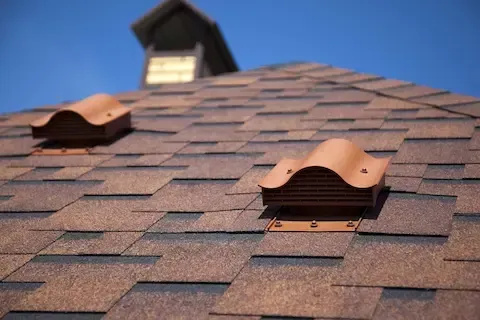
Box vents, sometimes called static vents or louvers, are individual square or rectangular units cut into the roof deck and spaced at intervals near the peak. Each one handles a defined square footage of attic space. They rely on the same convective principle but work in discrete zones rather than continuously across the full ridge. Both systems are passive, meaning neither requires electricity or a powered motor to function.
Airflow Capacity: Running the Numbers
The standard ventilation benchmark used by most roofing professionals is 1 square foot of net free area (NFA) for every 150 square feet of attic floor space, assuming balanced intake and exhaust. A quality continuous ridge vent typically delivers between 12 and 18 net free area inches per linear foot, depending on the product. On a 40-foot ridge, that's roughly 480 to 720 square inches of NFA — equivalent to the combined output of 6 to 9 box vents, each rated at around 80 square inches.
For a typical Conway-area home with a 1,500 square foot attic, you'd need at least 10 square feet of NFA total. A full ridge vent installation can meet that threshold from a single continuous strip. Box vents can reach the same number, but you need enough of them spaced appropriately across the upper portion of the roof to avoid dead zones where heat traps without an escape path. Undercounting box vents is one of the most common attic ventilation mistakes on residential installations in this area.
Weather Sealing Differences in Arkansas Conditions
Faulkner County weather includes significant rainfall events, high humidity, and occasional ice in winter months. Both vent types can perform well or fail based on installation quality, but they have different vulnerability profiles.
Ridge vents with external baffles are designed to deflect wind-driven rain away from the opening, and most quality products carry wind-driven rain certifications. When installed correctly with appropriate overlap and fastening, they hold up well to the severe thunderstorms common in central Arkansas from spring through fall. However, a poorly installed ridge vent with inadequate baffles can allow water intrusion along the entire ridge — a wide problem rather than a contained one.
Box vents have smaller individual footprints, which limits the damage from any single failed unit. A cracked or improperly flashed box vent typically leaks in one localized area. On the other hand, if a box vent is installed on a low-slope section or in a location prone to debris accumulation, water pooling becomes a concern. In Conway and surrounding Faulkner County neighborhoods where large oak and sweet gum trees are common, leaves packing against box vents over the fall season can reduce airflow and create moisture problems.
Roof Shape and Which Option Fits Better
Roof geometry plays a significant role in this decision. Homes with simple gable roofs and a single continuous ridge are well-suited to ridge vent installation — the geometry supports it directly. Homes with complex hip roofs, multiple intersecting valleys, dormers, or short ridge runs present real challenges for continuous ridge vents, because the usable ridge length may be too short to provide adequate NFA.
Many homes in the Conway area — particularly in established neighborhoods like Oak Forest and near Lake Conway — were built with hip roof configurations or have later additions that interrupt a clean ridge line. For these homes, box vents often deliver more practical coverage because they can be positioned on multiple roof planes rather than confined to a single ridge. A roofing professional evaluating your specific structure can calculate whether your ridge geometry provides enough linear footage to justify a ridge vent approach or whether box vents fill the gap more effectively.
Installation Cost Considerations
Ridge vent installation typically involves cutting a continuous slot along the roof peak, which is more labor-intensive than cutting individual holes for box vents. Material costs vary, but a quality ridge vent product runs roughly $1 to $3 per linear foot before installation. On the other hand, you're replacing multiple individual units with a single continuous system, which can streamline the labor on uncomplicated roofs.
Box vents are generally less expensive per unit and faster to install in small quantities, making them a common choice for repairs or additions where a full re-roofing isn't on the table. If your home already has a functioning box vent system that's short on capacity, adding one or two units is typically a low-cost way to improve airflow. For Roof Ventilation decisions tied to a full roof replacement, the cost difference between the two approaches often narrows significantly because the labor is already partially accounted for in the larger project scope.
Common Mistakes to Avoid
Mixing ridge vents with box vents on the same roof is a well-documented problem. When both are present simultaneously, airflow can short-circuit — air exits through the box vents before completing the convective sweep across the attic, leaving dead zones where heat builds. If you're installing a ridge vent, existing box vents near the peak should be closed or removed. Soffit vents at the eave remain the appropriate intake source.
Another frequent error involves installing ridge vents without ensuring adequate soffit intake. A ridge vent on a sealed soffit system creates negative pressure that can pull conditioned air from your living space into the attic rather than drawing outdoor air from below. Before committing to a ridge vent upgrade, verify that your soffit ventilation is clear and correctly sized. You can review our attic ventilation breakdown for a more detailed look at balanced intake and exhaust principles.
Making the Right Call for Your Home
For most Faulkner County homes with straightforward gable rooflines and adequate soffit ventilation, a continuous ridge vent is the higher-performing long-term choice. It distributes exhaust evenly, handles Arkansas storm conditions well when properly installed, and eliminates the guesswork of spacing multiple individual units. For complex roof shapes, hip configurations, or targeted repairs on existing systems, box vents remain a practical and reliable solution. The decision ultimately depends on your roof's geometry and the condition of your current ventilation baseline — both of which a qualified local roofing contractor can assess before any materials are ordered.
